
You’ve signed the lease. The fit-out programme is agreed. The opening date is in the diary and the marketing has gone out.
Then someone asks about the internet.
If you’re ordering a leased line at that point, you’re already behind. So how long does a leased line take to install? In the UK, typically 60 to 90 working days, and sometimes considerably longer. That’s three to five months of calendar time, not weeks.
Here’s what actually happens during that period, what causes the delays, and when you need to place the order to open on a proper connection rather than a temporary one.
How long does a leased line take to install in the UK?
Most UK providers quote a standard lead time of 45 to 90 working days. In practice, a realistic planning assumption for a new site is 90 working days from order to live.
The range is wide because no two installations are the same. Here’s roughly how it breaks down:
| Stage | Typical duration |
|---|---|
| Order processing and provider survey | 5–10 working days |
| Desktop planning and route design | 10–15 working days |
| Wayleave agreements (if required) | 20–60+ working days |
| Civil works (digging, ducting) | 10–30 working days |
| Fibre installation and testing | 5–10 working days |
| Router configuration and handover | 2–5 working days |
Some of these run in parallel. Others don’t start until the previous one finishes. Wayleaves in particular can stop everything dead.
If your site already has fibre to the building and spare capacity in the duct, you might be live in six weeks. If your site is a listed building on a high street with a landlord in another country, you might be looking at six months.
Why does it take so long?
A leased line isn’t broadband. Broadband shares an existing connection with everyone else on your street. A leased line is a dedicated physical fibre run from the exchange to your building, uncontended, symmetrical, with a service level agreement behind it.
That physical run has to be planned, permitted, and often dug. Which means several things have to go right.
Wayleaves
A wayleave is legal permission to install cable across land you don’t own. If the fibre route crosses a car park, a neighbouring property, or a landlord’s common area, someone has to sign.
This is the single biggest cause of delay on leased line installs. Not because it’s technically difficult, because it’s an administrative process that sits with people who have no deadline pressure. A landlord who takes three weeks to reply has just added three weeks to your opening.
Civil works
If there’s no existing duct to your building, Openreach or your provider’s contractor needs to dig one. That means street works permits from the local authority, traffic management if it’s a busy road, and a crew booked in.
Permit lead times vary by council. In some areas it’s two weeks. In others it’s considerably more, particularly if your site is in a conservation area or a pedestrianised zone.
Site readiness
The fibre terminates somewhere physical. That location needs power, needs to be accessible, and needs to exist by the time the engineer turns up.
Openings often fall down here. The comms room is still a stud wall on the day the install is booked, so the engineer leaves and you go back into the queue.
What happens if you order too late?
You open on 4G or a temporary broadband line. That’s the honest answer.
Picture a 90-cover restaurant on a Saturday night. Card payments, EPOS syncing to head office, CCTV recording to cloud, guest Wi-Fi, background music streaming, the booking system, and staff devices. All of it running through a consumer broadband router or a 4G dongle.
It usually holds until it doesn’t. Peak service is exactly when contended connections fall over, and that’s the moment you find out. Card machines time out. Orders don’t reach the kitchen. Guests notice.
You also end up paying twice, the temporary line, then the leased line, and running a second migration a few months after opening when the team is already stretched.
When should you order? The 90-day rule
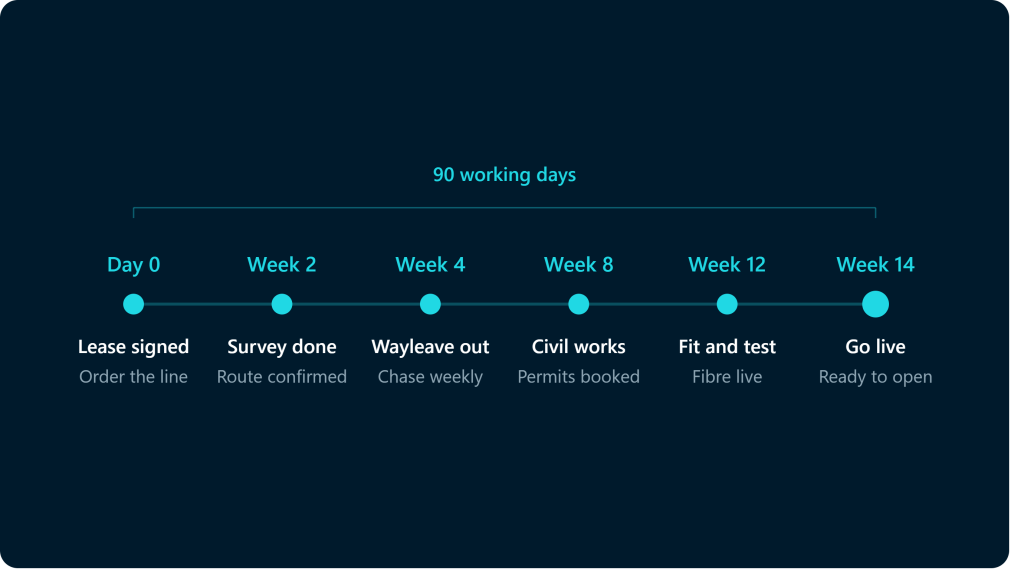
Order your leased line at least 90 working days before your planned opening date. For a multi-site group, build it into the standard site opening process so it happens automatically.
The best trigger point is the moment the lease is signed. Not when the fit-out starts. Not when the build programme is agreed. At heads of terms, you know the address, and the address is all the provider needs to start a survey.
If you’re working backwards from an opening date, here’s the sequence:
- Day 0 (lease signed): Order the leased line. Request a site survey.
- Week 2: Provider confirms route, flags any wayleave requirements.
- Week 4: Wayleave paperwork issued to landlord. Chase weekly from here.
- Week 8: Civil works booked if required.
- Week 10: Comms room location confirmed with the main contractor, power specified.
- Week 12: Install and testing.
- Week 14: Live and tested ahead of soft launch.
Order a backup connection at the same time. A 4G or 5G failover circuit costs very little and means a single fibre fault doesn’t stop trade.
Who owns this in your business?
This is the part that catches multi-site operators out.
The building has a main contractor. Someone owns the programme, coordinates the trades, and answers for the date. The technology usually has three or four separate suppliers, all working to their own timelines, with nobody joining them up.
The leased line provider doesn’t know when the EPOS is being installed. The EPOS supplier assumes the network is ready. The CCTV installer turns up expecting cabling that nobody ordered.
Somebody has to own the technology programme the way your contractor owns the build. On the openings we run for multi-site hospitality groups, that’s the role we take, one point of contact, one programme, costed upfront and planned around the build. Site five then runs smoother than site one, because the process is the same every time.
You can read more about how we approach IT projects for new site openings and our work across multi-site hospitality.
The short answer
Leased lines take 60 to 90 working days in the UK, and longer if wayleaves or civil works are involved. Order at lease signing, plan for 90 days, get a 4G failover as standard, and give one person ownership of the whole technology programme.
Do that and connectivity becomes the boring part of your opening. Which is exactly what it should be.
Planning a new site opening?
Our Site Opening Blueprint walks through the full technology timeline for a new hospitality site, what to order, when to order it, and what to have agreed before the fit-out begins.
Visit our Contact Us page and fill in the form with the message ‘Blueprint‘ to get your free copy.
Or call us on 0330 313 0966 and we’ll talk through your opening programme.