
IT downtime in hospitality costs more than most operators realise. You already know what a quiet Saturday costs you, but few can say what an hour of downtime does to the P&L. That gap is where the money quietly goes.
This post puts a real number on it. It covers what downtime actually costs a hospitality business once you count everything, why the sector gets hit harder than most, and what reducing IT downtime in hospitality looks like in practice. No jargon, no scare tactics, just the maths most operators have never been shown.
What does IT downtime actually cost a hospitality business?
The repair bill is the smallest part of it.
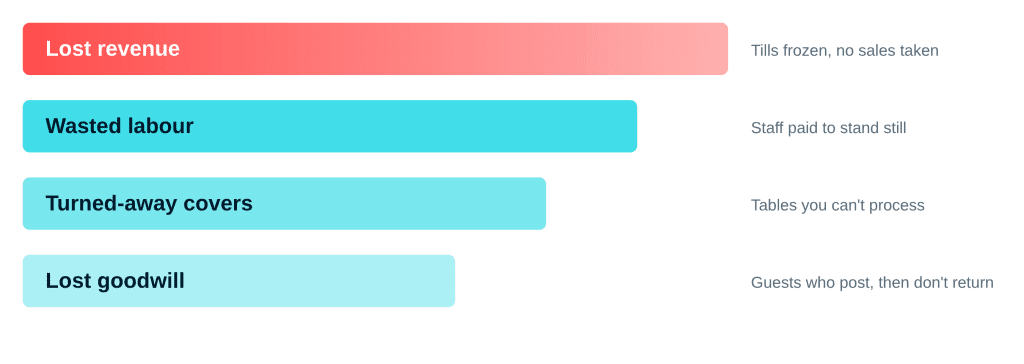
When your EPOS goes down mid-service, the cost stacks up across several lines at once. There’s the revenue you can’t take while tills are frozen. There’s the labour you’re still paying for staff who can’t work at full pace. There’s the covers you turn away because you can’t process them. And there’s the goodwill you spend on customers whose night you’ve disrupted.
A 40-cover restaurant in Chester doing an average spend of £35 a head loses around £1,400 in covers for every hour of a full Saturday-night outage. That’s before staff cost, before refunds, before the table that walks out and posts about it.
Run that across a multi-site group and a single bad evening can cost more than a month of IT support.
Why does hospitality suffer more downtime than other sectors?
Three reasons, and they compound.
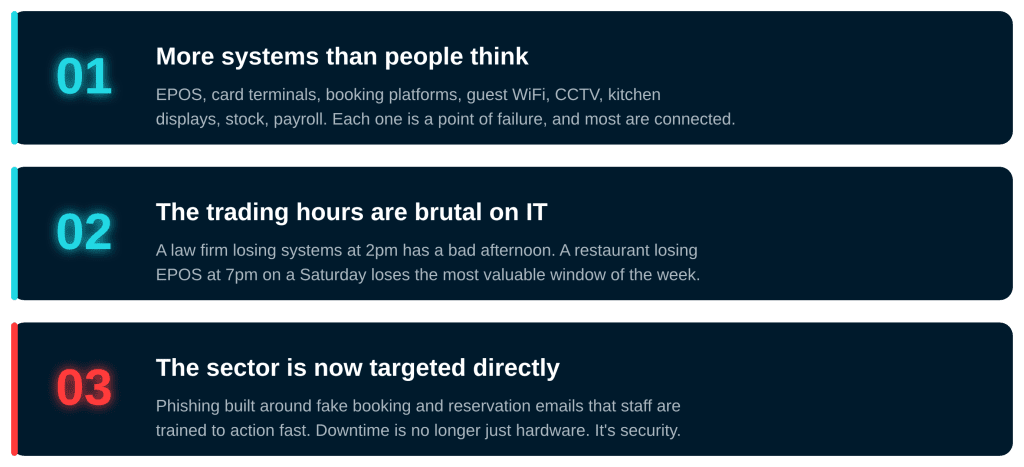
First, hospitality runs on more systems than people think. EPOS, card terminals, booking platforms, guest WiFi, CCTV, kitchen displays, stock and ordering, payroll. Each one is a point of failure, and most of them are connected.
Second, the trading hours are brutal on IT. A law firm that loses its systems at 2pm has a bad afternoon. A restaurant that loses EPOS at 7pm on a Saturday loses the most valuable trading window of the week, and there is no quiet period to recover in.
Third, the sector is now being targeted directly. Threat actors have built phishing campaigns specifically around hospitality workflows, using fake booking and reservation emails that staff are trained to action quickly. The National Cyber Security Centre has warned about exactly this kind of sector-specific social engineering. Downtime is no longer just a hardware question. It’s a security one.
The downtime nobody budgets for
Most operators plan for the obvious failures. A server dies, a router fails, a screen goes black. Those are visible and they get fixed.
The expensive downtime is the kind that arrives through an email.
A member of front of house clicks a link in what looks like a booking notification. Nothing appears to happen. Days later the systems lock, and the recovery runs into a second week while service limps along on paper. By then the cost has moved well past the IT line and into lost revenue, staff overtime, and in the worst cases, guest data on a leak site.
This is the downtime that doesn’t show up in any budget, because nobody plans for the thing they haven’t been told is happening.

What does reducing IT downtime in hospitality look like?
It comes down to a handful of things done consistently, rather than one big purchase.
- Monitoring that catches failures before service does. Systems should be watched around the clock so problems surface before a manager finds out from a frozen till.
- Backups that are tested, not assumed. A backup nobody has restored from is a hope, not a plan. It should be tested on a schedule.
- Support that covers your actual hours. A 9-to-5 IT contract is no use to a business trading until midnight, seven days a week.
- Workforce who know what the current threats look like. Most incidents start with a person, not a machine. Short, specific training on what to watch for closes the biggest gap most operators have.
- Cyber Essentials certification. It forces the basics into place and is increasingly expected by insurers and partners.
None of this is exotic. The businesses that avoid expensive downtime are not the ones spending the most. They are the ones who treat IT as an operational risk, the same way they treat food safety or fire.
The bottom line
Hospitality margins in 2026 are tight enough without losing a weekend to an outage you could have prevented. The real cost of downtime is never the repair bill. It’s the trading you lose, the staff you pay to stand still, and the customers who don’t come back.
If you don’t know what an hour of downtime would cost your business, that’s the first thing worth working out. The second is making sure it happens as rarely as possible.
Not sure where your business stands? Book a free 30-minute IT review and we’ll tell you straight where your risks are. Call 0330 313 0966 or visit our hospitality IT page.